The Power of Purpose-Driven Leadership
When I first stepped into a management role, I said something that made a colleague raise her eyebrow. She asked how I wanted to approach my new team. I said, “I want to build a happy and healthy team.” Her answer? “Good luck.”
But after more than two decades as an empowerment trainer, I already knew it was possible, because I’ve built my career around living and leading with purpose.

“People don’t buy what you do; they buy why you do it.” Simon Sinek
When I first stepped into a management role, I said something that made a colleague raise her eyebrow. She asked how I wanted to approach my new team. I said, “I want to build a happy and healthy team.”
Her answer? “Good luck.”
But after more than two decades as an empowerment trainer, I already knew it was possible, because I’ve built my career around living and leading with purpose.
Results are not born from control, but from belief.
Years earlier, when I worked as a teacher at a social work college, I told my students on day one that I expected each of them to have an average grade of eight by the end of the year. My colleagues laughed. “You have to be realistic, Mara.”
But when all of my classes reached that exact result, the laughter turned into silence and maybe even envy.
It taught me something vital: results are not born from control, but from belief. You cannot create what you cannot see.
When I was hired to manage a team years later, the organization was in the middle of a fusion, two companies merging into one. It was chaotic, politically charged, and full of uncertainty. So, I asked my manager a simple question: “What’s your vision?” He couldn’t answer. In fact, he seemed almost intimidated by the question.
That silence told me everything. It gave me space to create a vision for my teams, but it also revealed the company’s deepest wound.
Without vision, ego takes the lead. And when leadership is rooted in ego, there’s no room for growth, only competition, insecurity, and survival.
Vision gives direction, purpose gives life
Over the years, I’ve learned that a vision gives direction, but purpose gives life. A happy and healthy team was my vision, but my purpose went deeper: to unlock potential.
Because when people tap into their potential, something extraordinary happens. They don’t just perform better, they become better. They feel more alive, more confident, more connected. Purpose awakens the part of us that believes, I can grow.
The why is what people feel before they understand what you do.
That’s where Simon Sinek’s Why theory resonates deeply with me. He teaches that every great leader starts with why, the core reason that fuels meaning, motivation, and movement.
The why is what people feel before they understand what you do. It’s the emotional undercurrent that connects individual purpose to collective vision.
My why has always been clear: to help people see their own potential and rise from that awareness.
Once you understand why you lead, how you lead begins to transform. You start leading with energy instead of authority, with trust instead of control.
Many leaders focus on performance metrics, deadlines, and outcomes. But performance is a byproduct of purpose. People are not inspired by control, they are inspired by connection.
I never focused on perfection. I focused on creating the right energy field. One where people felt seen, safe, and significant. Because once someone feels safe enough to rise, performance becomes a natural consequence of that trust.
Leadership isn’t about being followed, it’s about activating potential.
Purpose-driven leadership isn’t abstract or idealistic. It’s precise, intentional, and profoundly human. It’s knowing that when people experience their own growth, they automatically raise the collective frequency of the team.
The most powerful organizations are not built on competition, but on conscious alignment. When everyone understands the why, the how becomes effortless.
When individual dreams align with a collective mission, work stops being pressure, and becomes purpose in motion.
I had built a team of leaders, not followers.
After five years, when it was time for me to shift to a higher purpose, I felt proud.
I had built a team of leaders, not followers. Leaders who began to take their own passion more seriously. Leaders who became happier with themselves, and for whom personal growth had become a core value.
That was the true success. Because I realized that I cannot help others if I don’t help myself first. And when you lead from that awareness, leadership stops being a role, it becomes a reflection of your own evolution.
Learn how to build purpose-driven, emotionally intelligent, and high-performing teams at Mara Michels PR, where strategy meets soul, and leadership becomes legacy..
Love, Mara

GRATITUDE: How It Transforms Team Dynamics, Energy, and Innovation
Gratitude creates psychological safety. When people feel seen, they feel safe to speak up, share ideas, and even fail forward. This is where co-leadership grows. Success stops being “mine” or “yours.”It becomes “ours.” Gratitude also makes change easier, turning fear into curiosity and curiosity into innovation.

Picture this.
It’s Monday morning.
The office hums with deadlines, coffee machines, and notifications.
In the meeting room, the first things shared?
Complaints. Problems. Frustrations.
The energy drops.
By 10:00 AM, everyone is doing the bare minimum.
The spark is gone. The ideas that could move the project forward stay locked inside.
This is how absenteeism begins: not just physical absence, but emotional and creative absence. The quiet quitting of enthusiasm. And at the root of it all? A lack of gratitude.
The Moment Gratitude Walks In
Same Monday. Same meeting. But this time, the team starts with one simple question:
“What’s one thing you’re grateful for from last week?”
At first there’s hesitation. Then someone mentions a breakthrough with a client. Another thanks a colleague for stepping in.
The room softens. Smiles spread. Laughter bubbles up. Ideas start to flow again.
Gratitude just walked into the room, and raised the vibration for everyone.
From Survival to Flow
Gratitude is not just nice manners. It’s an energetic reset.
Stress drops, focus sharpens, and creativity wakes up.
People move out of survival mode and into flow, that sweet spot where work feels lighter, solutions come naturally, and collaboration feels alive.
And when one person finds flow, it spreads. Soon the whole team is co-creating instead of competing, innovating instead of firefighting.
Safety, Trust, and Growth
Gratitude creates psychological safety. When people feel seen, they feel safe to speak up, share ideas, and even fail forward.
This is where co-leadership grows. Success stops being “mine” or “yours.”It becomes “ours.”
Gratitude also makes change easier, turning fear into curiosity and curiosity into innovation.
Simple Practices, Big Shifts
Start meetings with one thing you appreciate.
End the week by sharing your “win of the week.
Celebrate effort and learning, not just outcomes.
Reflect together on challenges and find the lesson.
These small rituals anchor gratitude into the culture and remind everyone: We are in this together.
The Ripple Effect
Gratitude is contagious. One person can shift a room.
One team can transform a culture.
When gratitude becomes the way you work, absenteeism drops, engagement rises, and innovation thrives. Because gratitude doesn’t just change what you do, it changes who you are together.
Join Me
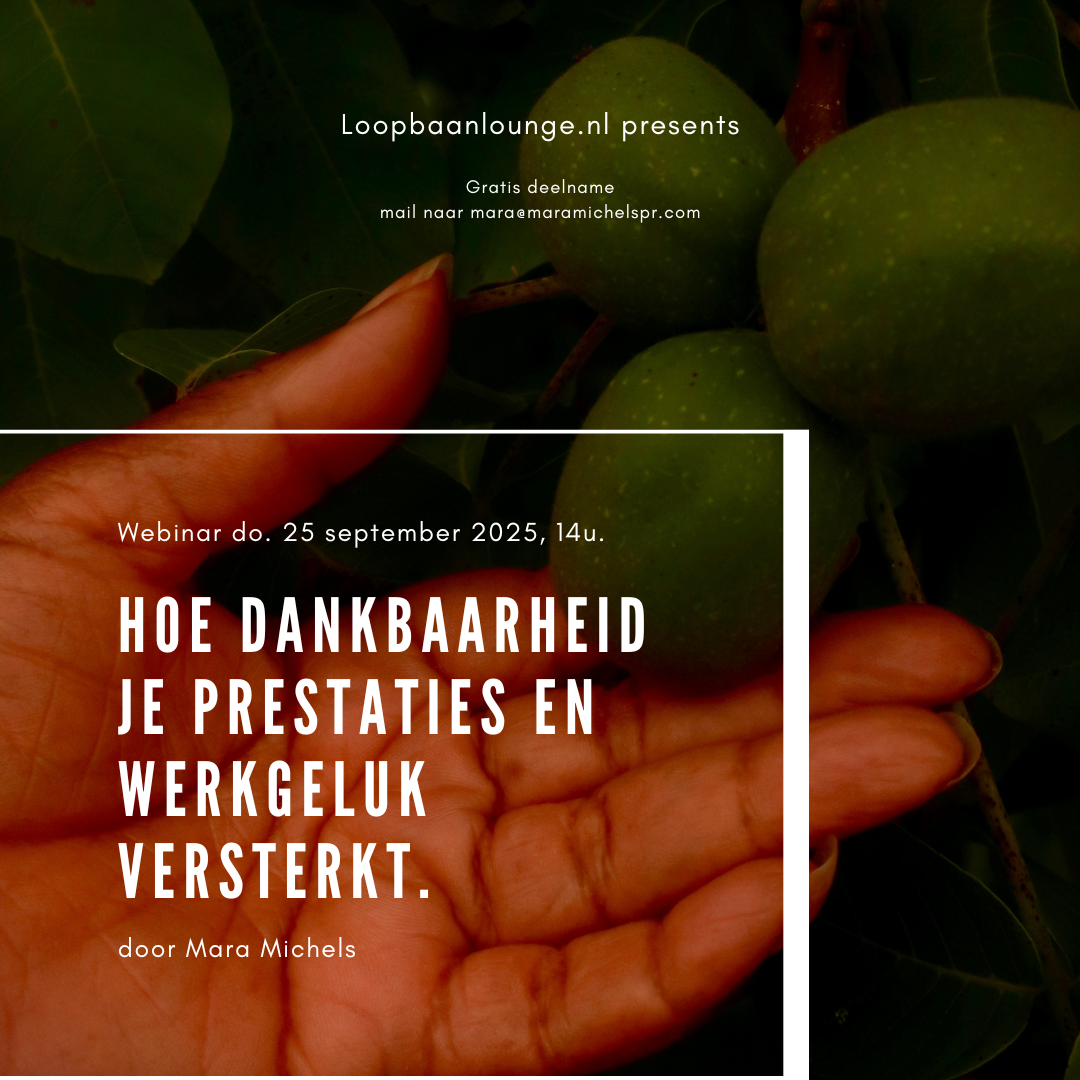
On Thursday, September 25, 2pm. I’ll be hosting a free webinar (in Dutch) with Loopbaanlounge.nl:
“Hoe dankbaarheid je prestaties en werkgeluk versterkt.”
Sign up by emailing me at mara@maramichelspr.com or DM me on Instagram. Let’s raise the vibration of your workday together.