
MEET HER: Oshun, The River Goddess of Beauty, Desire & Divine Authority
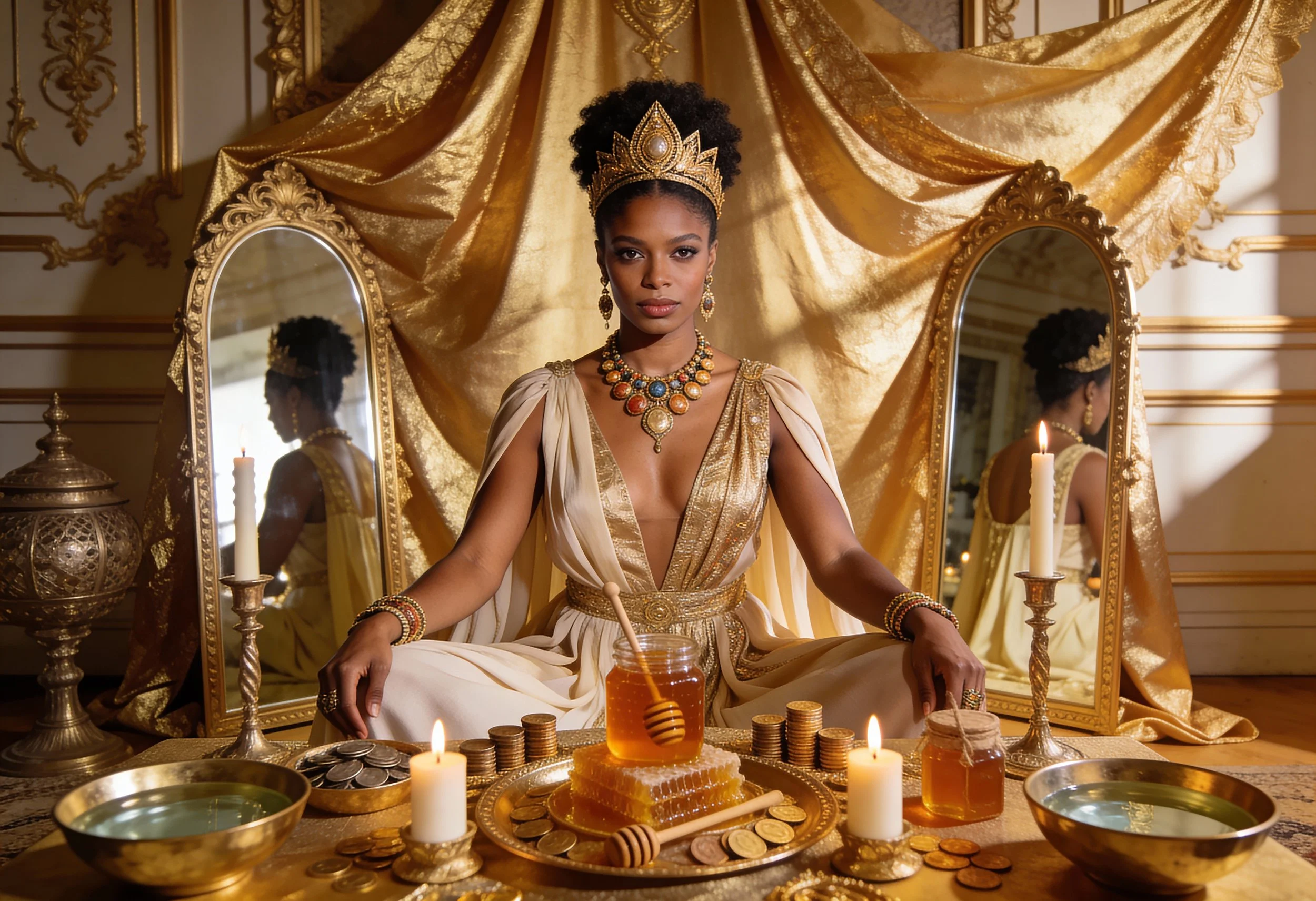
‘Meet HER’: An Introduction to the World of Goddesses, Archetypes, and Our Matriarchal Memory
Long before spirituality became something abstract or symbolic, goddesses were living frameworks. They were not distant figures placed on pedestals, but active forces woven into daily life, community, land, body, emotion, and decision-making. Goddess traditions are matriarchal memory systems. They teach us how life flows, how power moves, how creation survives, and how imbalance reveals itself.
To meet a goddess is not to escape reality. It is to recognize a truth that has always been operating beneath it.
In modern language, we often call these forces archetypes. Not because they are imaginary, but because they are recurring patterns of energy that surface across cultures and centuries. You do not need belief to encounter them. You meet a goddess when a certain phase of life demands her wisdom.
This is what Meet HER is about. Not worship as performance, but recognition. Not mythology as nostalgia, but mythology as lived experience.
And few goddesses reveal this more clearly than Oshun.
Goddess Oshun
The River Goddess Who Refused to Be Ignored
Oshun is often mistaken for what glimmers first.
Gold. Honey. Sensuality. Soft laughter. The aesthetics of sweetness.
Many stop there.
But Oshun has never lived on the surface. What appears gentle is only the visible layer of something far more commanding. She is depth that moves with ease. Power that does not announce itself. Authority that does not need permission.
To truly know Oshun, you have to move past the image and into the current.
Because Oshun does not merely represent beauty. She governs attraction itself. Not only the kind that plays out between lovers, but the deeper magnetism that shapes a life. The pull that draws in clarity, opportunity, resources, love, fertility, creativity. Not through effort. Not through pursuit. But through alignment.
Her power lies in this knowing. In the quiet certainty that when she flows, life responds. And when she withdraws, everything that depended on her sweetness is forced to reckon with its absence.
Oshun teaches a truth the world repeatedly forgets:
that attraction is a law, not a performance.
that softness can be sovereign.
that the river shapes the land not by force, but by persistence.
She was never meant to be ignored. And she never disappears quietly.The goddess before the trend
One of the most enduring stories tells how the male Orisha attempted to create the world without her. They believed strength, logic, and structure would be enough. Oshun, associated with sweetness and beauty, was dismissed as ornamental.
What followed was failure.
The rivers dried up. Crops withered. Rituals lost their power. The world had form, but no vitality. Creation stalled.
Only when they humbled themselves and acknowledged Oshun’s absence did they understand the truth. Creation cannot exist without feminine energy. Logic without intuition, strength without softness, order without pleasure leads to imbalance.
When Oshun returned, bringing her waters, the world breathed again.
Her lesson was never subtle. Without sweetness, nothing grows.
The river as archetype
Oshun governs rivers, not oceans, and this distinction matters. Rivers move through land with intelligence. They curve, adapt, and persist. They nourish everything around them while following their own path.
Oshun teaches that power does not always move in straight lines. Softness offers flexibility. Grace becomes strategy. What bends does not break.
She is associated with gold, honey, mirrors, copper, flowers, music, dance, fertility symbols, and sacred water. Her laughter is intoxicating. Her anger can flood lands. Oshun gives life, and when disrespected, she can withdraw it.
This is why she is adored and feared. She is not fragile. She is discerning.

Beauty, magnetism, and self-worth
In Oshun’s mythology, beauty is not decoration. It is authority. Beauty attracts, reveals, negotiates, and exposes truth. Sweetness draws out what force never could.
Oshun governs magnetism because she understands value. She does not try to be desirable. She is. Her presence elevates or exposes everything around her.
This is why working with Oshun often initiates clarity before comfort. She will not simply help you attract love or abundance. She will show you why you are drawn to what you seek. She reflects wounds, fantasies, and patterns without cruelty, but without illusion.
Her initiation can be confronting.
She breaks fantasy.
She checks ego.
She restores self-worth.
Her blade may be dipped in honey, but it is a blade nonetheless.
Why so many are drawn to her now
Many people arrive at Oshun after battle. After exhaustion. After religious trauma. After years of being strong, nurturing, fighting, surviving.
Oshun represents receiving. She represents pleasure without guilt. Desire without apology. Being cared for instead of always carrying.
In a world that glorifies struggle, her energy feels like relief.
But Oshun is not an escape. She is a mirror. She teaches that sweetness without self-respect leads to depletion. That giving without receiving dries the river. That softness requires boundaries to remain sacred.
She does not disappear to punish. She withdraws to teach.
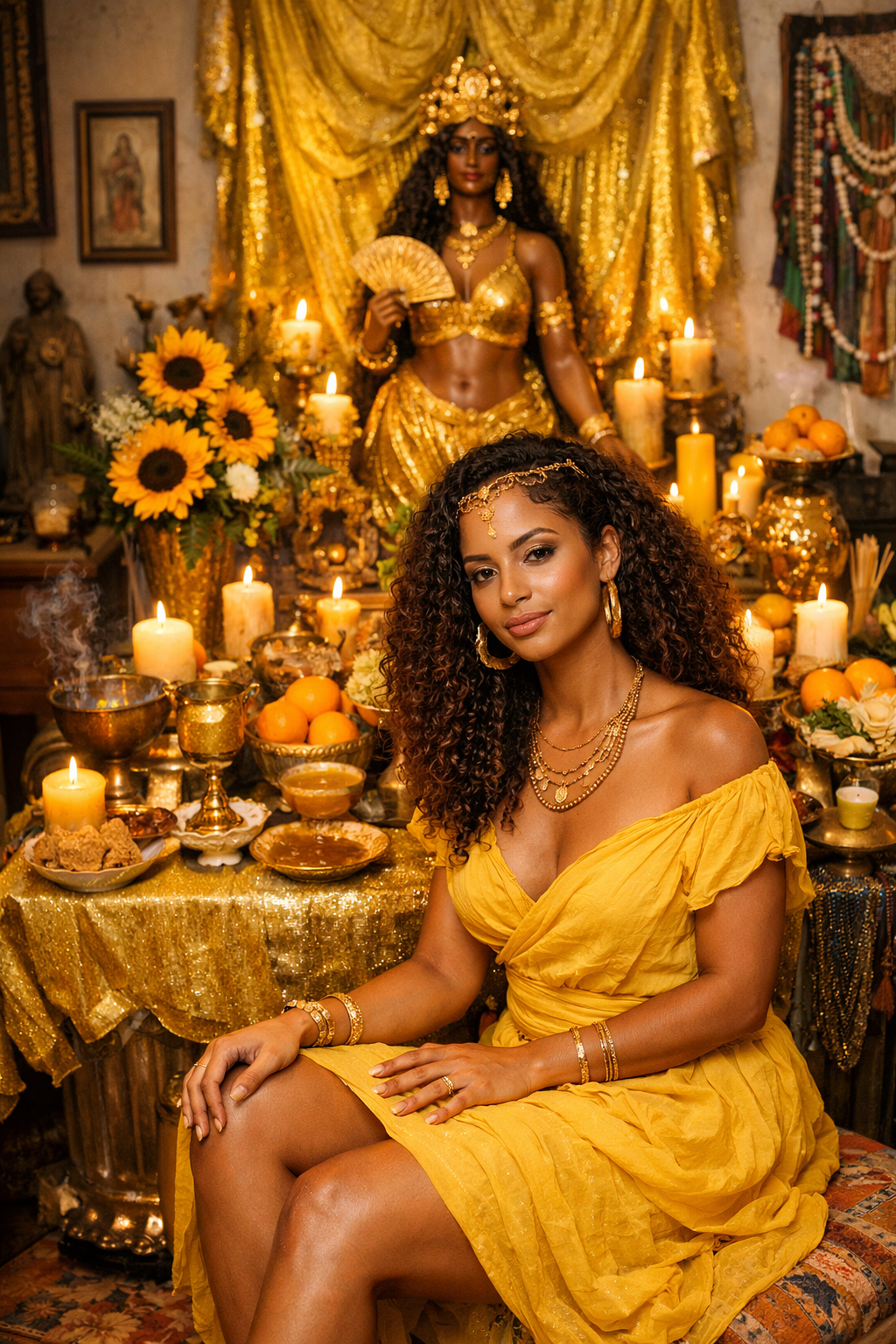
Working with Oshun
Within Yoruba traditions and Santería (Lucumí), there are sacred initiations through which someone may be recognized as a child of Oshun. These are not symbolic gestures or aesthetic choices. They are lineage-based rites, guided by elders, divination, and ancestral law. To belong to Oshun in this way is a lived commitment, one that comes with responsibility, discipline, protection, and service.
This path is not chosen out of admiration. It unfolds through initiation.
At the same time, Oshun is not only encountered through formal rites. Many women meet her through life itself. Through moments of exhaustion, longing, self-reclamation, and emotional awakening. Through seasons where force no longer works and something softer, truer is required.
To work with Oshun on this level is not about claiming her, but about aligning with what she represents. It is practicing gratitude before desire. Treating yourself with the care you expect from others. Slowing down. Beautifying your life with intention. Listening to your emotional body. Knowing when to stay, and when to walk away.
Oshun often arrives through dreams, intuition, synchronicities, and heightened awareness. In Yoruba cosmology, she is known as a messenger and intermediary, appearing to deliver insight rather than demand devotion. In these encounters, the message matters more than the image. The shift matters more than the ritual.
Oshun teaches that attraction follows alignment. That worth does not need to be proven. That the river flows best when it is respected.
Whether through sacred initiation or lived archetypal encounter, Oshun remains what she has always been: a force that does not ask to be possessed, only recognized.
Why goddesses still matter
Goddesses return when societies harden. When productivity replaces pleasure. When control overshadows connection. When femininity is reduced to performance instead of recognized as power.
They are not relics of the past. They are frameworks of remembering. To meet a goddess is to remember yourself in a deeper way.
And Oshun reminds us of this truth above all: You do not chase the river. You approach it with respect, or you remain thirsty.
When she is honored, life flows. When she is ignored, absence speaks. And when she returns, creation remembers how to breathe again.
Love, Mara
