
Must Watch: 'Gone Girl' A Love Story Between a Woman and Her Own Narrative
A BRIEF SUMMARY OF THE FILM
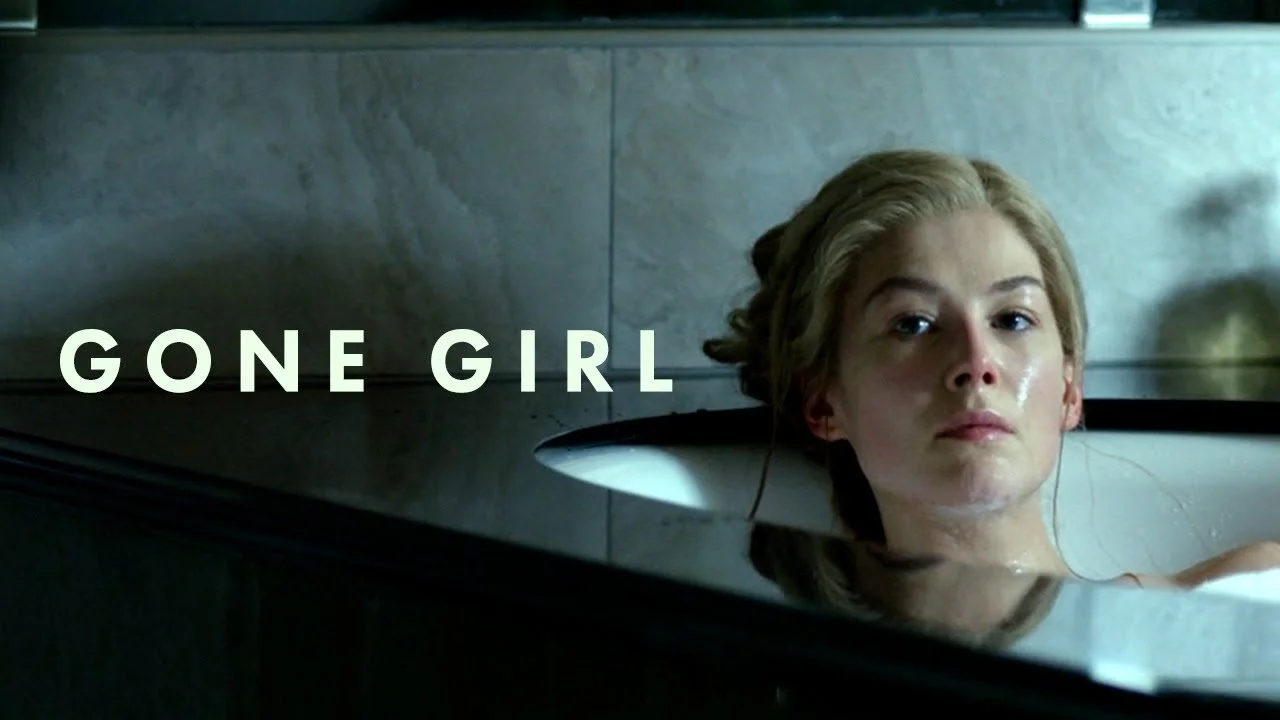
Nick and Amy Dunne appear to be a polished couple with a storybook sheen, until Amy vanishes on their anniversary and the house becomes a crime scene. The town, the police, and eventually the entire media machine turn their attention to Nick, who looks increasingly guilty under the spotlight. As the investigation unfolds, the film reveals that the marriage itself has been quietly rotting beneath its surface, built on performance, disappointment, and invisible power games. Then comes the true twist: Amy is not simply missing, she is directing the narrative, orchestrating an outcome, and weaponizing the way the world loves to categorize women. What follows is not only a thriller about marriage and suspicion, but a ruthless portrait of perception, archetypes, and the violence that can live inside a “perfect” image.
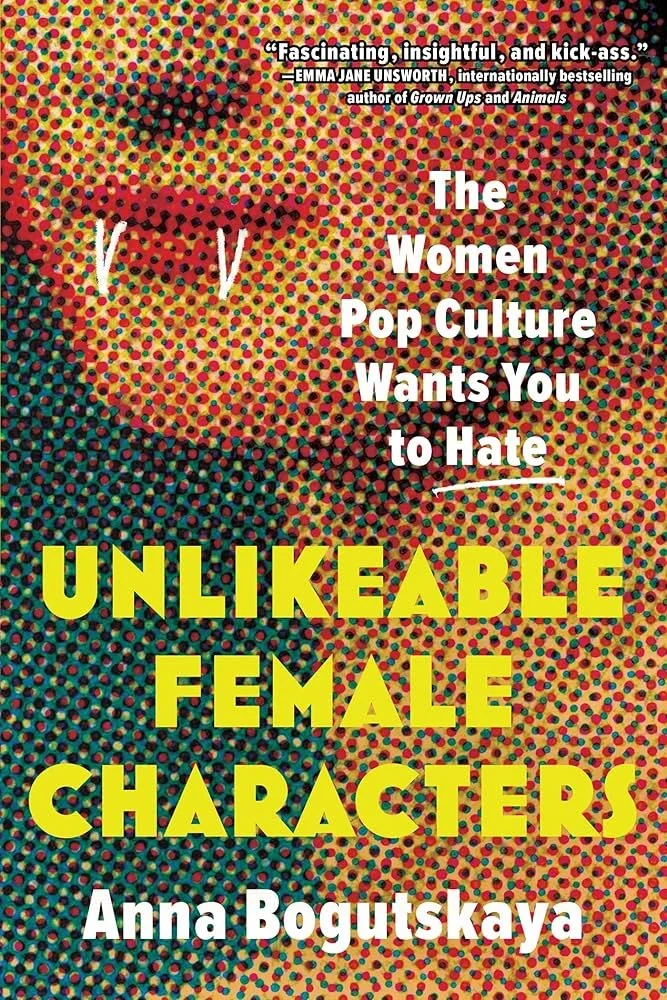
I was reading Unlikable Female Characters by Anna Bogutskaya on my Kindle, and when she highlighted Gone Girl, something shifted with a quiet, precise click.
I had already seen the film, I knew the twist, I knew the cultural hysteria it sparked, I knew how quickly Amy Dunne became a shorthand for everything people fear and fantasize about in women.
Still, I realized I had watched it the first time the way many of us are trained to watch women on screen: like a verdict waiting to happen. I watched to decide whether she was “too much,” “crazy,” “evil,” “brilliant,” “a warning,” “an icon.”
I watched to label her, and labeling is just a cleaner way of controlling what you refuse to understand.
Book on Amazon
Bogutskaya’s framing opened another door, not the door of approval and not the door of condemnation, but the door of perspective.
Suddenly Gone Girl stopped being a thriller I consumed and became a mirror that stared back, asking what I expect from a woman before she even speaks.
It made me notice how quickly stories demand that women be likable in order to be legible, and how “likability” is often just obedience in a polished outfit, sweetness as social currency, charm as a form of self-erasure.
The more I sat with that, the more the film transformed in my mind. It didn’t become a story about whether Amy was monstrous, but about what it means that audiences desperately need her to be either worshipped or erased.
That is the spell Gone Girl breaks when you watch it through a feminist lens, through the female gaze, through The Gaze itself as a concept.
Because the gaze isn’t only something that watches women. It is something that arranges women. It reduces women. It decides what kind of woman is “allowed” before she even begins.
THE MOVIE THAT LOOKS BACK
There is a particular kind of silence that falls when Gone Girl begins to tighten its grip. It is not the silence of comfort, but the silence of recognition, the moment you realize the film is not only showing you a marriage, but also the invisible rules that have been written onto women for generations. It is a story that understands something unsettling: women are not merely seen, women are assessed. Women are turned into conclusions. A face becomes a verdict. A smile becomes evidence. A body becomes a story other people feel entitled to finish.
The film does not ask you politely to consider this. It turns the camera into an eye that refuses to blink, and then it forces you to sit inside that eye. Because Gone Girl is not only about Amy Dunne. It is about the gaze that made Amy possible, and the public that participates in that gaze without admitting it.
THE GAZE AS A CONTRACT
The gaze in this film is not just “male” in the simplistic sense, because it is bigger than any one man.
It is a cultural gaze, a social gaze, a media gaze, a relationship gaze. It is the gaze of expectations that women learn to anticipate before they even learn what they want.
It is the gaze that says you can be loved, but only if you can be digestible. You can be adored, but only if you stay legible. You can be powerful, but only if you make that power feel harmless.
Amy understands this gaze the way some people understand weather. She knows which way it shifts. She knows when it gets dangerous. She knows what it rewards. Most of all, she knows what it punishes: a woman who becomes too complicated to be comfortably consumed.
Through Bogutskaya’s lens, you start noticing that the true thriller isn’t only Amy’s plan, but the world’s hunger for a simple story about a woman.
THE “COOL GIRL” AS A SURVIVAL COSTUME
When Amy speaks about the “Cool Girl,” it lands with the precision of something that has been rehearsed in the private theater of the female mind for years. The Cool Girl is not simply a type, she is a survival costume. She is the woman who eats burgers and stays tiny, who laughs at his jokes and never makes him feel guilty, who is sexy without wanting anything, who is laid-back without being neglected, who is effortlessly beautiful but never “high maintenance,” who is agreeable but still “not like other girls.” She is the fantasy woman who does not require a man to grow, and does not require a relationship to hold emotional weight.
The psychological cruelty of the Cool Girl is that she looks like freedom. She looks like confidence. She looks like choice. Yet under the surface she is often a contract, and the price of that contract is the quiet abandonment of self.
A woman becomes a performance that must keep winning, because the moment she stops performing, the room changes temperature. The love feels conditional. The admiration becomes fragile. The relationship begins to feel like an audition where the role is “easy.”
What Bogutskaya helps name, without asking for permission, is that many “unlikable” women are simply women who are done paying that price.
THE VILLAIN AS A REFUSAL
Amy, in her most chilling moments, is not just angry at Nick. She is angry at the entire marketplace of womanhood, where being chosen is treated as the final prize and staying chosen is treated as a woman’s job.
She is angry at the expectation that a woman must be endlessly flexible, endlessly forgiving, endlessly flattering, endlessly capable of shrinking her reality so someone else can keep feeling comfortable inside it.
In that sense, Amy becomes the villain in the way that women often become villains in real life: not necessarily because they are immoral, but because they become unmanageable.
A woman can be called cruel when she is simply done.
A woman can be called crazy when she is simply clear.
A woman can be called dangerous when she stops negotiating.
The word “villain” is frequently used as a social leash. It is the label that appears when a woman refuses to be arranged into the shapes that make other people feel safe. Bogutskaya’s work makes you see how often “unlikable” is just the polite version of “she won’t cooperate.”
BREAKING THE ARCHETYPE CAGE
This is where Gone Girl breaks barriers with a kind of dark elegance. The film refuses to turn Amy into a moral lesson. It does not soften her into a wounded girl who needs saving.
It does not punish her in the clean way stories often punish women who step outside the lines. It does not offer you the comfort of redemption as a tidy ending, because redemption, in female storytelling, is often just another cage decorated with flowers.
Instead, Amy stays authored. That is the disruptive thing, and it is also the reason she fascinates. Amy is not the “good woman,” and she is not the “broken woman,” and she is not the “bad woman” who exists to be punished or corrected.
She is something that makes audiences uneasy because it collapses the usual categories, and because she exposes how much society relies on those categories to keep women readable.
THE PSYCHOLOGY OF NARRATIVE CONTROL
Amy’s most terrifying power isn’t her beauty. It is her ability to shape perception. She understands what people will believe, because she understands what people want to believe. She knows that public truth is rarely the most accurate story. Public truth is often the most coherent story, delivered with the right emotional cues, the right timing, the right aesthetic, the right performance of innocence.
This is not a celebration of her actions, and it does not need to be. The respect that the character demands is not rooted in morality, but in the fact that she exposes the machinery. She reveals, without blinking, how quickly a woman’s identity is made for her, and how violently she can be punished when she refuses the version that is preferred.
This is where the female gaze sharpens: it stops asking, “Do I like her?” and starts asking, “What system made her the only kind of woman the story will pay attention to?”
THE RELATIONSHIP AS A COURTROOM
At the heart of Gone Girl is a relationship that becomes a courtroom. Nick and Amy do not repair, they prosecute. They do not meet each other, they manage each other.
They do not ask, “What do we need?” They ask, “What do I look like in your story?”
The intimacy dies not in one dramatic betrayal, but in a slow erosion of truth, where both people begin to perform, and then begin to punish each other for the performance.
The film shows the quiet horror of love turning into optics, and partnership turning into a brand. It shows how quickly intimacy collapses when perception becomes more important than presence, and how the gaze can turn a private relationship into a public trial where a woman is expected to be both saint and spectacle.
WHY THE VILLAIN FEELS LIKE A MIRROR
Amy is extreme, but the questions she provokes are intimate. The film asks what it does to a person to live as an image for too long, and what happens when a woman realizes she has been valued more as an idea than as a human being. It confronts the viewer with how female anger is often delegitimized, how female complexity is often punished, and how “likability” is often treated as a moral requirement.
In this way, the villain arc becomes a paradoxical kind of liberation for the audience, because it breaks the cliché that female power must be nurturing to be acceptable.
It refuses the stereotype that a woman must be soft to be human. It refuses the cultural demand that a woman’s complexity must be apologized for, explained away, or redeemed through suffering.
Bogutskaya’s point hums beneath it all: the “unlikable” woman is often the woman who refuses to disappear for your comfort.
WHAT THE GAZE LEARNS
If you watch the film through the lens of the gaze, the takeaway is not “become HER.” It is “become real.”
It becomes clear that you do not have to become a villain to break stereotypes, but you may have to outgrow the need to be seen as “good.” Because goodness, in many rooms, is just obedience with a halo, and likability is often the price women pay to move safely through the world.
The film leaves you with a quieter question than shock or outrage. It leaves you with a question that lingers like perfume on fabric, refusing to disappear.
Where in your life have you been performing womanhood instead of living it, and what would it look like to stop editing yourself for the gaze?
CLOSING: BEYOND THE ARCHETYPES
You do not need Amy’s spectacle to take the lesson. You do not need the revenge fantasy. What you need is the moment she represents in the cleanest form: the moment a woman stops negotiating her humanity.
A woman can be warm without being easy. A woman can be powerful without being cruel. A woman can be complex without being “wrong.” A woman can be adored without performing for the gaze. And when she becomes that, the gaze has to evolve, because it can no longer own her with a stereotype.
It can only witness her.
Love,
Mara Michels
